The final conference of the “Micro-Credentials for Higher Education Systems of Georgia and Armenia: South Caucasus Lighthouse project” (Micro-GEAR) co-funded by EU Erasmus+ Program took place in Tbilisi on 5 November and was hosted by the project coordinator, Georgian Technical University (GTU). The event brought together representatives of project partner institutions from Armenia, Georgia and EU countries, as well as representatives of government bodies, quality assurance agencies and the international expert community.
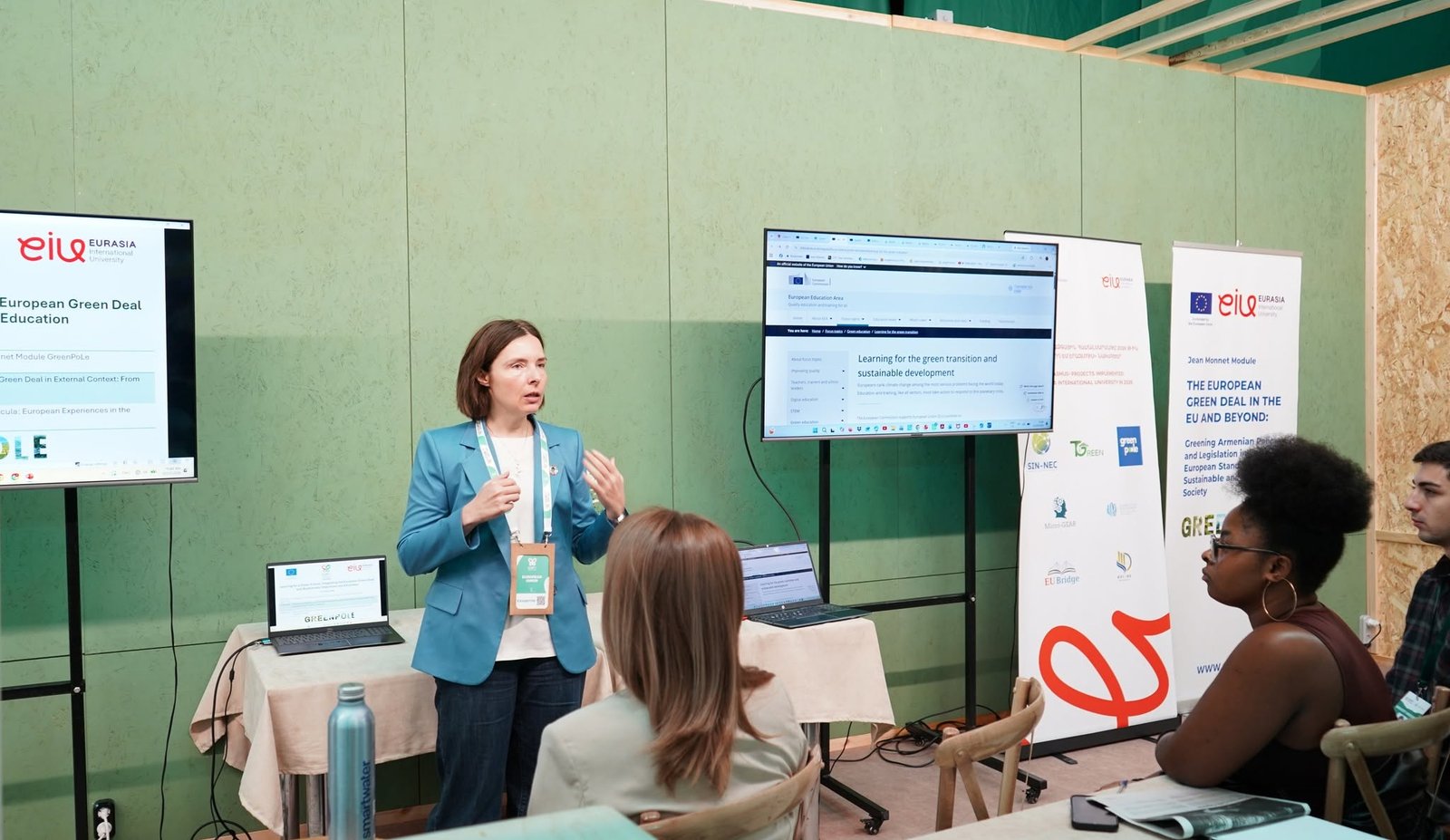
Eurasia International University (EIU), a member of the project consortium, was also represented at the conference by a delegation headed by Dr Ruben Markosyan, Vice-Rector for Academic Affairs, PhD, Associate Professor. As part of the conference, Dr Markosyan participated in a panel discussion entitled “Micro-credentials in Armenia today and the influence of Micro-GEAR”. During the panel discussion, he presented the micro-credential program developed and implemented at Eurasia International University within the framework of the project. The panel addressed the challenges encountered during the micro-credential program’s implementation and the approaches adopted to overcome them. Participants also discussed plans and initiatives aimed at ensuring the project’s sustainability.
The conference provided an opportunity to review the project’s key achievements and outcomes, with particular attention to regulatory frameworks, the integration of micro-credentials into national qualifications frameworks, quality assurance, digital certification and European best practices in the field of micro-credentials. The conference highlighted the significant contribution of the Micro-GEAR project to the development of micro-credential systems and the expansion of educational opportunities in the South Caucasus.
The Micro-GEAR project consortium brings together 16 partner institutions from Armenia, Georgia, Germany, Spain and Italy and is coordinated by Georgian Technical University. The other consortium partners are the University of Georgia, Ministry of Education, Science and Youth of Georgia, National Center for Educational Quality Enhancement (Georgia), Georgian Research and Educational Networking Association, Saarland University (Germany), Universidad Carlos III de Madrid (Spain), European University of Rome (Italy), Academic Equivalence Mobility Information Center (Italy), GIRAF PM (Germany), Center for Ecological-Noosphere Studies of the National Academy of Sciences (Armenia), Ministry of Education and Science of the Republic of Armenia, Yerevan State University (Armenia), Eurasia International University (Armenia), Armenian National Quality Assurance and the Armenian National Information Center for Academic Recognition and Mobility.